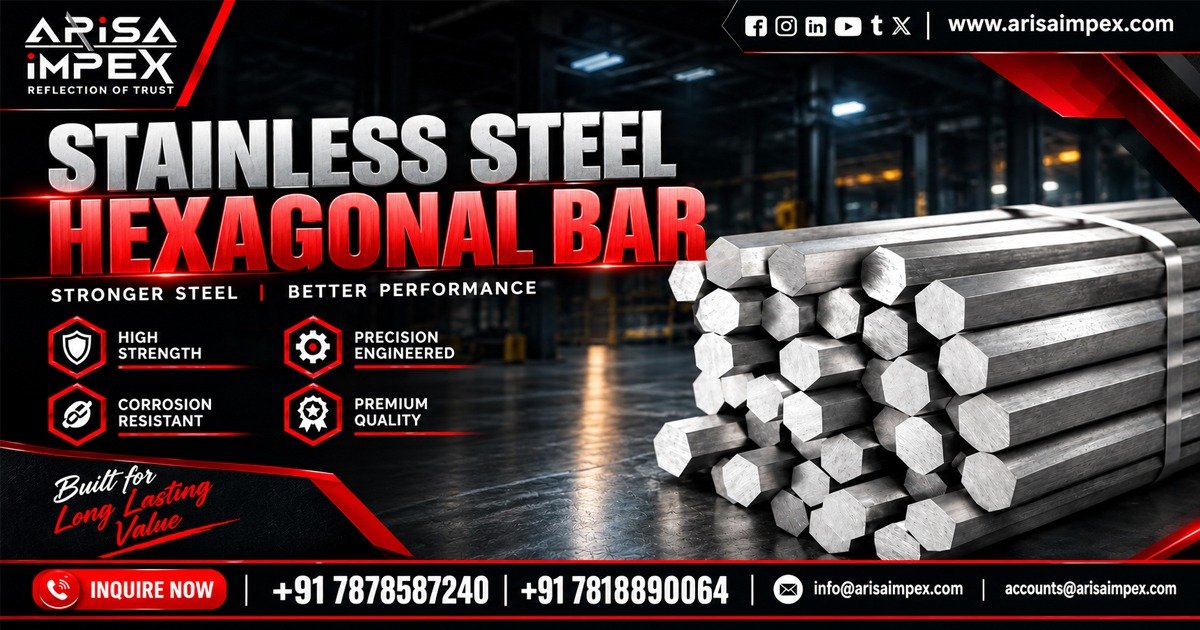
Stainless steel hexagonal bars are essential for precision machining and industrial component manufacturing. Businesses searching for a reliable Stainless Steel Hexagonal Bar Supplier In Gujarat can explore suitable grades, dimensions and finishes from Arisa Impex.
Why Hexagonal Stainless Steel Bars Are Used in Precision Engineering
A stainless steel hexagonal bar is a solid metal product with six flat sides and a uniform hexagonal cross-section. Its shape makes it suitable for manufacturing components that require accurate machining and convenient gripping during production.
Unlike round bars, hexagonal bars provide flat surfaces that are useful when producing fasteners, nuts, threaded components and specialised engineering parts.
Industries commonly use these bars for:
- Manufacturing nuts, bolts and industrial fasteners.
- Producing valve stems and machine components.
- Fabricating couplings and connecting parts.
- Manufacturing automotive and engineering components.
- Producing precision-machined industrial fittings.
The stainless steel composition also helps provide resistance to corrosion, depending on the selected grade and operating environment.
For manufacturers, selecting the correct bar is important because material properties, machining performance and dimensional accuracy directly influence the finished component.
Choosing the Correct Grade, Across-Flat Size and Finish
Before purchasing stainless steel hexagonal bars, buyers should evaluate the actual application rather than selecting material based only on price.
The following factors help simplify product selection.
1. Stainless Steel Grade
Different grades provide different mechanical and corrosion-resistance properties.
| Grade | Common selection considerations |
| SS 201 / 202 | General fabrication and applications with suitable environmental conditions |
| SS 303 | Machining-intensive components |
| SS 304 / 304L | General industrial and fabrication requirements |
| SS 316 / 316L | Applications requiring improved corrosion resistance |
| SS 310 / 310S | Selected high-temperature environments |
| SS 410 / 420 | Applications requiring specific strength and hardness characteristics |
| SS 17-4 PH | Engineering components requiring precipitation-hardening properties |
The grade should be confirmed according to chemical exposure, temperature, mechanical loading and machining requirements.
2. Across-Flat Dimensions
Hexagonal bars are generally measured across their opposite flat surfaces. This measurement determines the size of the finished component and should match the machining drawing.
Arisa Impex lists a size range of 16 mm to 55 mm for its hexagonal bar offering. Confirm the required availability before placing an order.
3. Surface Finish
The required finish depends on the manufacturing process and final application.
Common options include:
- Bright finish
- Black finish
- Peeled finish
- Smooth turned finish
- Rough turned finish
- Centreless ground finish
- Cold-drawn finish
- Annealed finish
4. Length and Tolerance
Standard listed lengths are 4 to 6 metres, with other requirements subject to confirmation. Buyers should also specify dimensional tolerance, straightness and cutting requirements.
5. Quantity and Production Planning
Consider the number of components to be manufactured, expected material wastage and future procurement requirements. Ordering suitable lengths can help reduce unnecessary cutting waste.
From Raw Bar Selection to a Finished Machined Component
Stainless steel hexagonal bars are commonly processed through machining operations to produce components with specific dimensions and functional surfaces.
A typical manufacturing workflow involves the following stages.
Step 1: Material Identification
The required stainless steel grade is selected according to the component drawing, working environment and mechanical requirements.
Step 2: Bar Measurement and Cutting
The incoming material is checked for its across-flat dimension and length. It is then cut into suitable blanks according to the production plan.
Step 3: Machining and Component Formation
The hexagonal blank is processed using suitable machining equipment. Operations may include turning, drilling, threading, milling and other machining procedures.
Step 4: Final Inspection
The finished component is checked for dimensional accuracy, surface condition, thread quality and other drawing-related requirements before assembly or dispatch.
The actual process may vary depending on component geometry, production volume and the required finish.
What Buyers Should Inspect Before Confirming an Order
Material mismatch or incorrect dimensions can create production delays and increase machining costs. A proper incoming inspection helps identify problems before the bars enter the manufacturing process.
Buyers should verify the following points:
- Grade identification: Check whether the supplied material matches the purchase order.
- Material test documentation: Request a material test certificate (MTC), where applicable, to verify chemical composition and mechanical properties.
- Dimensional accuracy: Measure the across-flat dimension and check the specified tolerance.
- Surface condition: Look for visible cracks, dents, deep scratches, scale or other surface irregularities.
- Straightness: Check whether the bars are suitable for the intended machining operation.
- Quantity and length: Verify the number of bars, individual lengths and total supplied quantity.
- Traceability: Ensure that material identification and batch details are maintained where required.
Buyers should also confirm the applicable material specification and inspection requirements in the purchase order. Standards such as ASTM A276 and ASTM A484 are listed on Arisa Impex’s product information; the relevant standard should be confirmed for the ordered product.
Arisa Impex
How Surface Processing Affects the Final Component
The surface condition of a hexagonal bar can influence machining preparation, dimensional accuracy and the appearance of the finished component.
For example:
- Bright or cold-drawn finish: Can be suitable where a cleaner surface and closer dimensional control are required.
- Peeled finish: Provides a processed surface for applications where the original outer surface needs removal.
- Centreless ground finish: Used when specific surface and dimensional requirements call for grinding.
- Annealed condition: May be selected where the material requires a suitable heat-treated condition for further processing.
- Turned finish: Can help prepare the surface for subsequent machining operations.
The buyer should discuss the required finish with the supplier and machining team before ordering. A more refined finish is not automatically necessary for every component.
Arisa Impex also lists value-added processing options such as heat treatment, surface machining, trepanning, precision bar cutting, chemical milling and turned, ground and polished (TGP) processing. Availability should be confirmed against the particular grade and order requirement.
Services
- Stainless steel grade and dimensional requirement consultation.
- Hexagonal bar selection based on machining and fabrication needs.
- Discussion of surface finishing and value-added processing requirements.
- Product enquiry coordination and technical specification assistance.
Gujarat’s Industrial Demand for Stainless Steel Hexagonal Bars
Gujarat has a diverse industrial base covering engineering, automotive components, chemical processing, pharmaceuticals, fabrication, machinery and infrastructure. These industries require suitable stainless steel raw materials for manufacturing and maintenance activities.
Hexagonal bars can support the production requirements of engineering workshops, fastener manufacturers, machine component manufacturers and industrial fabrication businesses.
Important business and industrial locations include Ahmedabad, Surat, Vadodara, Rajkot, Gandhinagar, Bharuch, Ankleshwar, Vapi, Valsad, Jamnagar, Bhavnagar, Morbi, Mehsana, Sanand, Halol, Kalol, Dahej, Mundra, Kandla, Gandhidham, Junagadh, Anand, Nadiad, Navsari and Porbandar.
For businesses searching for a Stainless Steel Hexagonal Bar Supplier In Gujarat, selecting a supplier that understands material grades, machining requirements and dimensional specifications can make procurement more organised.
How Arisa Impex Supports Stainless Steel Material Requirements
Selecting industrial steel involves more than comparing quotations. Buyers need to communicate the intended application, material grade, dimensions, finish and quantity clearly.
Arisa Impex offers stainless steel products, including hexagonal bars, as part of its industrial material range. Its product information covers multiple stainless steel grades, dimensional options and surface finishes.
With manufacturing support from Ahmedabad, Gujarat, India, the company can discuss material requirements for different industrial applications.
Customers can visit https://arisaimpex.com/ to explore its stainless steel product range and contact the team regarding their requirements.
For a more accurate enquiry, buyers should share:
- Required stainless steel grade.
- Across-flat dimension.
- Required bar length.
- Surface finish and tolerance.
- Quantity and delivery location.
- Intended machining or industrial application.
This information helps establish whether the proposed material is suitable for the intended production requirement.
Frequently Asked Questions
Q1: Which stainless steel grade is suitable for hexagonal bars used in machining?
A: SS 303 is commonly considered for machining-intensive applications, while SS 304 and SS 316 are selected for different corrosion-resistance requirements. The final choice depends on the component and operating conditions.
Q2: What dimensions should I provide when ordering a hexagonal bar?
A: Specify the across-flat dimension, length, tolerance, material grade and surface finish. Sharing a technical drawing can further clarify the requirement.
Q3: How do I choose between bright and peeled hexagonal bars?
A: Bright finishes are useful when a cleaner surface and dimensional control are required. Peeled bars are considered when the outer surface needs to be removed during processing. Select according to the machining process.
Q4: What documents should I request when purchasing stainless steel hexagonal bars?
A: Ask for applicable material test certificates, grade identification and inspection documentation. Also confirm the specified material standard and batch traceability requirements before accepting the supply.
Conclusion
Choosing the right hexagonal bar requires attention to grade, dimensions, tolerance and surface finish. Industrial buyers across Gujarat can evaluate these factors before procurement. Arisa Impex, with manufacturing support from Ahmedabad, Gujarat, India, can discuss stainless steel material requirements for different engineering applications.
Contact Arisa Impex to discuss your stainless steel hexagonal bar requirements, product specifications and industrial procurement needs.
Website: www.arisaimpex.com
E-Mail Id: info@arisaimpex.com, accounts@arisaimpex.com
Phone: +91 7878587240 | +91 7818890064