Selecting the right stainless steel bar is important for component strength, machining accuracy, and corrosion resistance. SS 304 and SS 316 Bright Round Bars for Industrial Applications help manufacturers meet different engineering requirements with suitable material selection and dependable sourcing from Ahmedabad.
Understanding the Role of Bright Round Bars in Precision Manufacturing
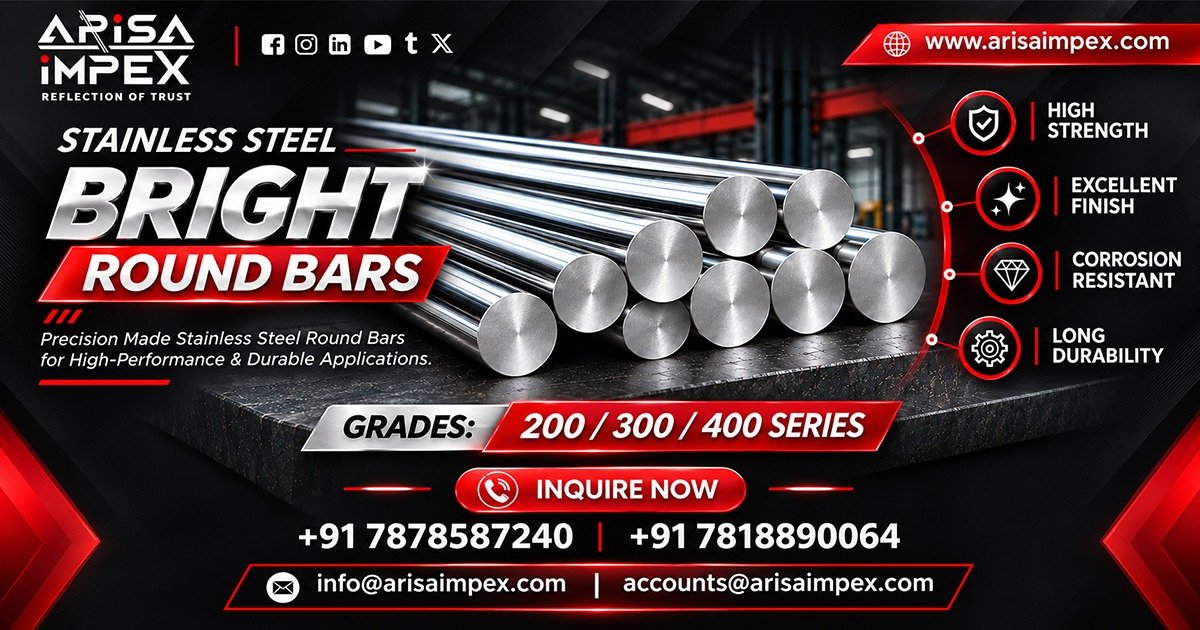
Stainless steel bright round bars are solid cylindrical metal products used as raw materials for manufacturing precision-engineered components. They are commonly produced through cold drawing or other finishing processes that improve surface appearance and dimensional accuracy.
Unlike rough-finished bars, bright round bars generally have a smoother surface and more controlled dimensions. This makes them useful where machining accuracy, consistent diameter, and surface quality are important.
Two commonly selected grades are SS 304 and SS 316. Although both belong to the austenitic stainless steel family, their chemical compositions and corrosion-resistance characteristics differ.
SS 304 Bright Round Bars
- Contain chromium and nickel as their main alloying elements.
- Offer good resistance to corrosion in many general industrial environments.
- Provide good formability and weldability.
- Are commonly selected for machinery, food-processing equipment, fabrication, and general engineering components.
SS 316 Bright Round Bars
- Contain molybdenum in addition to chromium and nickel.
- Provide improved resistance to chloride-related corrosion compared with SS 304.
- Are considered for marine, chemical-processing, and demanding industrial environments.
- Suit components that may experience contact with saltwater or certain aggressive chemicals.
The correct grade depends on the working environment, exposure conditions, mechanical requirements, and expected service life.
Choosing Between SS 304 and SS 316 for Your Production Needs
Selecting a stainless steel grade based only on its price or appearance can create problems during operation. Buyers should understand the actual conditions in which the finished component will work.
Consider the following factors before purchasing:
| Selection Factor | SS 304 | SS 316 |
| Corrosion resistance | Good for many general environments | Improved resistance in chloride-containing environments |
| Chemical composition | Chromium and nickel | Chromium, nickel, and molybdenum |
| Typical environment | General industrial and indoor applications | Marine and selected chemical environments |
| Machinability | Suitable for conventional machining with correct tooling | Requires suitable tooling and machining practices |
| Material cost | Generally more economical | Generally higher due to alloy composition |
| Common selection | General engineering components | Components exposed to more demanding environments |
Other purchasing factors include:
- Diameter: Select the required bar diameter according to the finished component dimensions and machining allowance.
- Length: Check whether standard lengths or cut-to-size material will suit your production process.
- Surface finish: Consider bright drawn, centreless ground, or polished finishes according to the required accuracy.
- Dimensional tolerance: Confirm diameter tolerance and straightness requirements before ordering.
- Operating environment: Evaluate moisture, chemicals, temperature, and chloride exposure.
- Quantity: Match the order quantity with production schedules and material storage capacity.
- Machining requirements: Consider turning, drilling, threading, grinding, and other machining operations.
A clear technical specification helps reduce material selection errors and unnecessary machining adjustments.
From Raw Steel to a Finished Engineering Component
The performance of a finished component depends on both the selected stainless steel grade and the machining process. Bright round bars provide a convenient starting material for different manufacturing operations.
The typical production workflow involves the following stages:
Step 1: Material Grade Verification
The manufacturer or buyer identifies whether SS 304 or SS 316 is suitable for the intended application. Material documentation and chemical composition should be checked against the purchase requirements.
Step 2: Cutting to Required Length
The selected round bar is cut according to the dimensions of the component. Proper cutting helps prepare the material for further machining while managing material wastage.
Step 3: Machining and Component Formation
Depending on the design, the bar may undergo turning, drilling, threading, milling, or grinding. Suitable cutting tools and machining parameters are important because stainless steel can generate heat and experience work hardening during machining.
Step 4: Final Inspection
The machined component is checked for dimensional accuracy, surface condition, and conformity with the drawing. Additional testing may be required depending on the component’s intended function.
These stages help manufacturers maintain consistency between incoming raw material and finished engineering parts.
Quality Checks That Matter Before Ordering Stainless Steel Bars
Material quality should be evaluated through measurable specifications rather than surface appearance alone. A shiny finish does not independently confirm the grade or mechanical properties of stainless steel.
Industrial buyers should verify the following points:
- Grade identification: Confirm that the supplied material is SS 304 or SS 316 as specified in the purchase order.
- Chemical composition: Request a material test certificate or relevant chemical analysis documentation when required.
- Dimensional accuracy: Check diameter, length, straightness, and applicable tolerances.
- Surface condition: Inspect for scratches, dents, cracks, scaling, and other visible defects.
- Mechanical properties: Verify tensile strength, hardness, and other specified properties through suitable test documentation.
- Manufacturing specifications: Confirm the applicable material specification and product requirements before finalizing the order.
- Packaging and handling: Ensure bars are properly protected during storage and transportation to avoid surface damage and material mix-ups.
Buyers should also confirm whether the supplied material is suitable for welding, machining, or other planned fabrication operations.
Matching Bar Dimensions and Finishing to Component Drawings
Different engineering projects require different bar dimensions and surface conditions. A standard diameter may work for general machining, while precision components can require tighter dimensional tolerances and additional surface finishing.
The selection should be based on the component drawing and manufacturing process.
Important project requirements include:
- Required diameter and overall length.
- Surface finish and machining allowance.
- Dimensional tolerance and straightness.
- Required stainless steel grade.
- Quantity and delivery schedule.
- Material documentation and inspection requirements.
Arisa Impex lists stainless steel bright round bars in multiple grades and provides product information covering different dimensions and finishing conditions. Buyers should confirm current availability and exact specifications before placing an order.
SERVICES
Arisa Impex supports stainless steel material requirements through the following product-related services:
- Stainless Steel Material Consultation: Assistance in understanding SS 304 and SS 316 grade requirements for different industrial applications.
- Bright Round Bar Selection: Guidance on selecting suitable grades, diameters, lengths, and surface finishes.
- Material Specification Coordination: Support in discussing dimensional requirements and relevant product documentation.
- Industrial Supply Coordination: Assistance with product enquiries, order quantities, and delivery planning.
LOCATION
Manufacturers and engineering businesses across Gujarat use stainless steel raw materials for machinery production, fabrication, automotive components, industrial equipment, and infrastructure projects. Manufacturing support from Ahmedabad, Gujarat, India is relevant to industrial buyers in Ahmedabad, Surat, Vadodara, Rajkot, Gandhinagar, Bharuch, Ankleshwar, Vapi, Valsad, Jamnagar, Bhavnagar, Morbi, Mehsana, Anand, Nadiad, Navsari, Junagadh, Porbandar, Gandhidham, Bhuj, Sanand, Kalol, Halol, Savli, and Dahej.
How Arisa Impex Supports Industrial Stainless Steel Requirements
Choosing a stainless steel supplier involves more than comparing quotations. Buyers need clear product information, suitable material options, and coordination according to their manufacturing requirements.
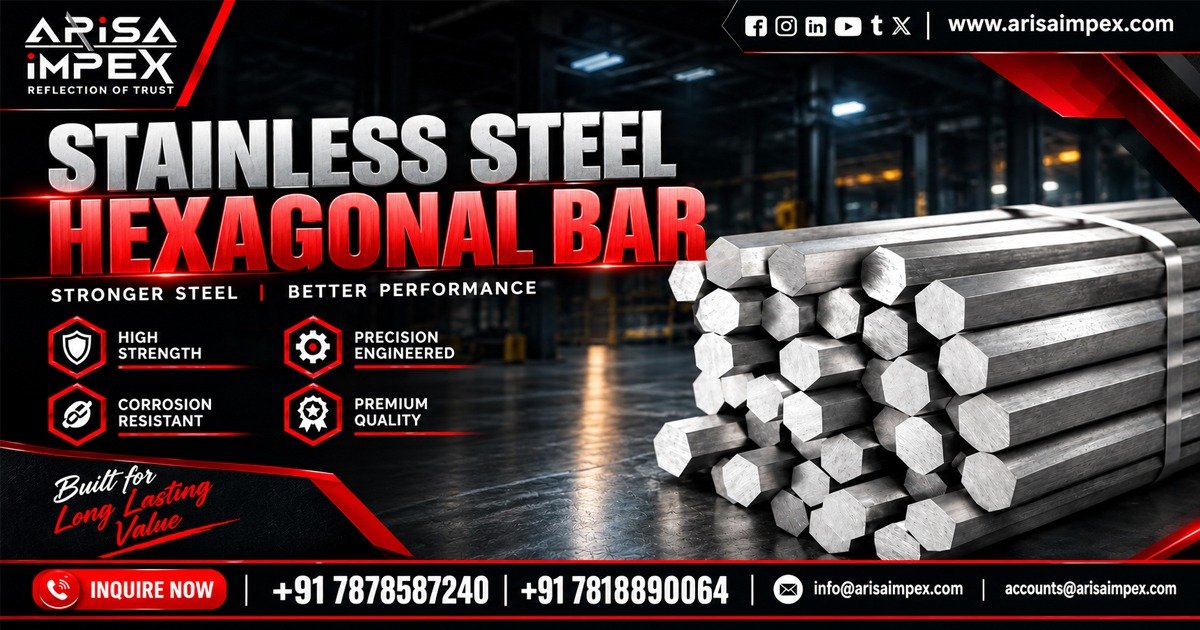
Arisa Impex deals in industrial stainless steel products, including stainless steel round bars, sheets, pipes, flat bars, square bars, hexagonal bars, and flanges.
For businesses sourcing SS 304 and SS 316 bright round bars, the company can be approached to discuss:
- Required stainless steel grade and product dimensions.
- Material suitability for machining and fabrication.
- Available product specifications and finishing options.
- Quantity, documentation, and delivery requirements.
With manufacturing support from Ahmedabad, Gujarat, India, Arisa Impex serves industrial material requirements across different markets.
Visit https://arisaimpex.com/ to explore its stainless steel product range and discuss your material sourcing requirements.
Frequently Asked Questions
Q1: What is the main difference between SS 304 and SS 316 bright round bars?
A: SS 304 is suitable for many general industrial environments, while SS 316 contains molybdenum, which improves its resistance to chloride-related corrosion. The choice depends on the working environment.
Q2: Are stainless steel bright round bars suitable for CNC machining?
A: Yes. Both grades can be used for CNC turning, drilling, threading, and other machining operations. Correct tooling, cutting speed, and feed settings are important for achieving the required finish and dimensions.
Q3: How should I determine the correct diameter of a bright round bar?
A: Refer to the component drawing, finished dimensions, machining allowance, and required tolerances. Selecting the appropriate starting diameter helps manage material consumption and machining time.
Q4: What documents should I request when purchasing SS 304 or SS 316 round bars?
A: Buyers can request a material test certificate, chemical composition details, mechanical test results where specified, and dimensional inspection records according to their purchase requirements.
Conclusion
Choosing suitable stainless steel round bars requires attention to grade, corrosion exposure, machining conditions, dimensions, and documentation. SS 304 and SS 316 bright round bars support different engineering requirements across Gujarat’s industrial sectors. Arisa Impex offers manufacturing support from Ahmedabad for businesses planning stainless steel material procurement.
Contact Arisa Impex to discuss your SS 304 and SS 316 bright round bar requirements, confirm product specifications, and receive assistance with industrial material selection.
Website: www.arisaimpex.com
E-Mail Id: info@arisaimpex.com, accounts@arisaimpex.com
Phone: +91 7878587240 | +91 7818890064