Industrial fabrication and engineering projects require stainless steel bars with suitable dimensions, material grades, and surface finishes. Arisa Impex supports buyers seeking reliable stainless steel flat bars in Ahmedabad, Gujarat, for varied industrial requirements.
Understanding the Role of Stainless Steel Flat Bars in Industrial Fabrication
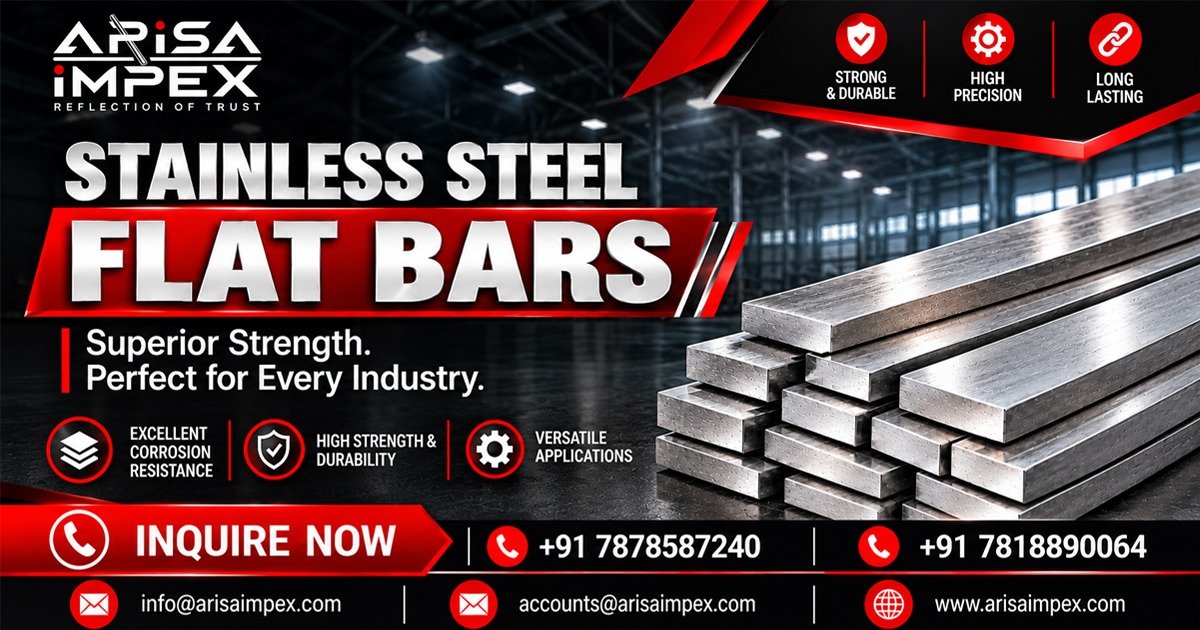
Stainless steel flat bars are solid metal products with a rectangular cross-section. They are used in fabrication, structural assemblies, machinery manufacturing, and engineering projects where dimensional accuracy and material strength are important.
Unlike round or square bars, their flat geometry makes them suitable for applications involving cutting, drilling, welding, bending, and joining.
Industries commonly use these materials for:
- Manufacturing support brackets and mounting plates.
- Fabricating machine frames and equipment structures.
- Producing industrial supports and connecting components.
- Building railings, platforms, and metal frameworks.
- Manufacturing components for chemical and pharmaceutical equipment.
- Creating custom-fabricated engineering parts.
The correct material grade is particularly important when components operate in environments exposed to moisture, chemicals, heat, or regular cleaning.
What Should Buyers Check Before Selecting a Flat Bar?
Choosing the right material involves more than selecting a width and thickness. Procurement teams should evaluate the working environment and fabrication requirements before finalising an order.
Important selection factors include:
- Stainless Steel Grade: Grade 304 is commonly considered for general corrosion-resistant applications, while Grade 316 is often selected for environments requiring greater resistance to chlorides and certain chemicals.
- Width and Thickness: Match the dimensions with engineering drawings and the required structural or fabrication purpose.
- Required Length: Confirm whether standard or project-specific lengths are suitable for cutting and fabrication.
- Surface Finish: Select an appropriate finish according to appearance, cleaning, machining, and operating requirements.
- Mechanical Requirements: Consider the strength, hardness, and fabrication characteristics required for the finished component.
- Operating Environment: Evaluate exposure to chemicals, moisture, temperature changes, and outdoor conditions.
- Quantity and Budget: Consider total material consumption, cutting wastage, transportation, and project deadlines.
A properly prepared purchase specification helps suppliers understand the requirement and reduces the possibility of ordering unsuitable material.
From Material Selection to Finished Component: How Flat Bars Are Used
Stainless steel flat bars generally pass through several fabrication stages before becoming part of an industrial assembly.
Step 1: Requirement Identification
The buyer identifies the intended application, material grade, dimensions, quantity, and operating conditions.
Step 2: Material Inspection
Before fabrication, the supplied bars should be checked for grade identification, surface condition, dimensional accuracy, and visible defects.
Step 3: Cutting and Processing
The material is cut according to the required length. Depending on the component design, additional operations may include drilling, machining, bending, or edge preparation.
Step 4: Fabrication and Assembly
Prepared sections are joined or assembled using suitable fabrication methods. Welding procedures should be compatible with the selected stainless steel grade.
Step 5: Final Quality Checking
The finished component is checked against the engineering drawing, dimensional requirements, surface expectations, and application specifications.
Following these steps helps maintain consistency between the purchased material and the final fabricated product.
Quality Checks That Matter Before Placing a Steel Order
Material quality directly affects fabrication results and the reliability of finished components. Buyers should establish clear inspection requirements before confirming procurement.
Consider checking the following:
| Inspection Parameter | What Buyers Should Verify |
| Material Grade | Confirm the specified stainless steel grade |
| Dimensions | Check width, thickness, and length |
| Surface Condition | Look for scratches, cracks, and unwanted defects |
| Dimensional Tolerance | Match measurements with project requirements |
| Material Identification | Verify grade and heat or batch traceability where required |
| Documentation | Request applicable material test certificates |
| Quantity | Confirm the supplied quantity against the purchase order |
| Packaging | Check protection against handling and transportation damage |
For critical engineering applications, material documentation and traceability should be discussed before order confirmation.
Buyers should also ensure that the material supplied matches the grade mentioned in the quotation and purchase order.
Matching Material Requirements with Different Project Specifications
Every industrial project has different material requirements. A flat bar used for a machinery support may have different dimensional and environmental requirements from one used in chemical equipment or architectural fabrication.
Before requesting a quotation, buyers should prepare:
- Required stainless steel grade and material specification.
- Width, thickness, and individual bar length.
- Total quantity or approximate material weight.
- Required surface finish.
- Cutting or machining requirements, if applicable.
- Intended application and operating environment.
- Delivery location and expected procurement schedule.
Sharing these details allows the supplier to understand the requirement more clearly and discuss suitable material options.
It is also useful to confirm whether the selected dimensions are readily available or require a separate sourcing arrangement.
SERVICES
- Product Requirement Consultation: Understanding application requirements, material grades, dimensions, and procurement needs.
- Material Selection Assistance: Helping buyers evaluate suitable stainless steel flat bar specifications.
- Order and Supply Coordination: Discussing quantities, material availability, packaging, and delivery planning.
- Technical Enquiry Support: Assisting with product-related questions and specification clarification before order confirmation.
LOCATION: Serving Industrial and Engineering Requirements Across Gujarat
Gujarat has a strong industrial presence across engineering, chemical processing, infrastructure, pharmaceuticals, fabrication, and manufacturing sectors. Stainless steel flat bars are relevant to businesses requiring dependable raw materials for machinery, equipment, structural fabrication, and industrial assemblies. With manufacturing support from Ahmedabad, Gujarat, India, Arisa Impex provides a contact point for buyers evaluating their stainless steel material requirements across Ahmedabad, Surat, Vadodara, Rajkot, Gandhinagar, Bharuch, Ankleshwar, Vapi, Valsad, Navsari, Jamnagar, Bhavnagar, Junagadh, Morbi, Mehsana, Anand, Nadiad, Sanand, Changodar, Halol, Kalol, Gandhidham, Bhuj, Porbandar, and Surendranagar.
Why Choose Arisa Impex for Stainless Steel Flat Bar Requirements?
Selecting a suitable supplier involves evaluating product availability, material specifications, communication, and procurement coordination.
Arisa Impex offers stainless steel flat bars as part of its industrial stainless steel product range. Buyers can discuss their requirements, including material grade, dimensions, quantity, and intended application.
The company has manufacturing support from Ahmedabad, Gujarat, India, helping buyers connect with a supplier for their stainless steel procurement requirements.
Visit Arisa Impex to explore its product range and enquire about stainless steel material requirements.
Frequently Asked Questions
Q1: Which stainless steel grade is suitable for industrial flat bar applications?
A: Grade 304 is commonly used for general industrial and fabrication requirements. Grade 316 may be more suitable for applications involving greater exposure to chlorides or certain corrosive environments. Final selection depends on operating conditions.
Q2: What dimensions should I specify when purchasing stainless steel flat bars?
A: Buyers should specify the required width, thickness, and length. Providing engineering drawings or a detailed dimensional schedule can help avoid material mismatches.
Q3: How should stainless steel flat bars be stored after delivery?
A: Store bars in a clean, dry area and protect them from contamination and contact with incompatible metals. Use suitable supports to prevent bending, scratches, and surface damage.
Q4: What information should I provide when requesting a quotation from a supplier?
A: Share the required grade, dimensions, quantity, surface finish, application, and delivery location. Mention any inspection or documentation requirements to make quotation evaluation easier.
Conclusion
Selecting suitable stainless steel flat bars requires attention to material grade, dimensions, surface finish, and operating conditions. Businesses in Ahmedabad and across Gujarat can evaluate their procurement requirements with Arisa Impex, supported by its manufacturing base in Ahmedabad, for informed material sourcing decisions.
Looking for stainless steel flat bars for your next industrial or fabrication project? Contact Arisa Impex to discuss your material specifications, quantity, and procurement requirements.
Website: www.arisaimpex.com
E-Mail Id: info@arisaimpex.com, accounts@arisaimpex.com
Phone: +91 7878587240 | +91 7818890064